
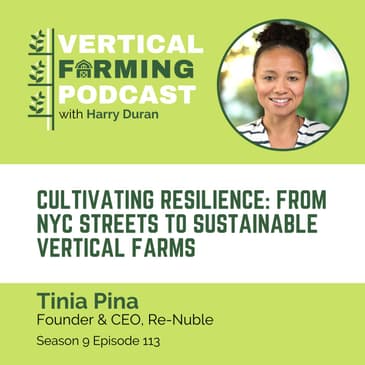
Can technology and privacy coexist in this rapidly evolving business landscape? This is a question we attempt to answer as we welcome Tinia Pina, the innovative Founder and CEO of Re-Nuble. Our riveting conversation explores the risks and rewards of navigating the digital world while protecting our privacy, and how we can leverage accessible technology to create sustainable products, without being swept up in the distractions of the tech world.
New York’s relentless energy can be overwhelming, but it also breeds resilience. Together with Tinia, we journey through the bustling streets of the Big Apple, delving into its unique influence on its citizens. We reflect on the significance of community and how to find balance amidst the city's frenetic pace. We then steer our discussion towards the revolutionary world of renewable resources and sustainable agriculture. Tinia shares compelling anecdotes about her professional journey, the resilience that New York cultivated in her, and why she founded the New York City Agriculture Collective.
The episode concludes with a fascinating discussion on the future of vertical farming, a disruptive practice that is reshaping the way we grow our food. We talk about the exciting potential of giving farmers more flexibility, from irrigation to material types. The potential of home farming and investment possibilities in produce security, particularly outside the United States, are also touched upon. Tinia's insights into these emerging trends offer a fresh perspective on the future of the industry. So join us for an episode packed with invaluable insights from a seasoned professional leading the way in the field of renewable resources and sustainable agriculture.
Thanks to Our Sponsors
AgTech Marketing Team
Key Takeaways
0:00:03 - Technology's Impact on Privacy and Business
0:04:45 - Finding Home, Balance in New York
0:08:48 - The Evolution of Renewable
0:21:58 - Challenges and Growth in Sustainable Agriculture
0:34:25 - Flexible Irrigation and Material Types
0:44:31 - The Future of Vertical Farming
Tweetable Quotes
"I've always needed to align my personal values with my professional work. The work that I needed to do needed to have a social mission, which is why we're a social enterprise. It's very easy and without any question, we need to have something that's going to directly give back in ways that the business can."
"We're essentially a social enterprise that focuses on developing and commercializing nutrients and fiber products that are meant to use byproducts from the food production industry, as well as crop residues, to turn them into organic, renewable materials to replace mineral salts and horticultural substrates."
"The biggest advantage has been for me of just removing any ego, any attachment, and I think that makes me a lot more lean. I lean into the team. I definitely create an environment where people feel like they're co-creating, they're contributing just as much as I in the sense of this is part of their vision as well."
Resources Mentioned
Tinia's Linkedin - https://www.linkedin.com/company/re-nuble
Tinia's Website - https://www.re-nuble.com
Tinia's Email - tinia@re-nuble.com
Tinia's Twitter - https://twitter.com/Re_Nuble
Tinia's Instagram - https://www.instagram.com/re_nuble/?hl=en
Tinia's Facebook - https://www.facebook.com/ReNuble/
Connect With Us
VFP LinkedIn - https://www.linkedin.com/company/verticalfarmingpodcast
VFP Twitter - https://twitter.com/VerticalFarmPod
VFP Instagram - https://www.instagram.com/direct/inbox/
VFP Facebook - https://www.facebook.com/VerticalFarmPod
Subscribe to our newsletters!
AgTech Digest - https://agtechdigest.com
The Indoor Farmer - https://www.indoorverticalfarm.com/
Horti-Gen Insights - https://www.hortigeninsights.com/
Sponsor Links
Cultivatd’s Website – https://cultivatd.com/
Cultivatd’s Instagram – https://www.instagram.com/cultivatdco/
Cultivatd’s Twitter – https://twitter.com/cultivatd
Cultivatd’s Facebook – https://www.facebook.com/cultivatd/
🎙️🎙️🎙️
Podcast Production and Marketing by FullCast
Discover the best podcast services in the world at The Podosphere: https://www.thepodosphere.com/
Mentioned in this episode:
2025 Precision Ag Report by iGrowNews
2025 Precision Ag Report by iGrowNews
[00:00:00] For me, I've always needed to align my personal values
[00:00:03] with whatever kind of professional work that I do.
[00:00:05] I used to work in finance, that culture was not for me,
[00:00:07] learned that very quickly, did what I did to need to adapt,
[00:00:10] but at the end of the day, I spent a lot of my time
[00:00:13] doing a lot of volunteer work through urban rooftop gardens
[00:00:16] at the time it was Brooklyn Bridge on a volunteer basis,
[00:00:18] taught through New York Cares,
[00:00:20] through a PrEP SAT program at Harlem.
[00:00:23] And that just really instilled that the work that I needed
[00:00:26] to do needed to have just a social mission, year and well worth the time. Special thanks again to the team at Verde Farm and ADF Summit. It's been great to connect with folks, new folks, fans of the show, past guests, partners, sponsors, so much fun to be in this industry and to see what's happening, see the excitement that's happening, and just have these face-to-face conversations. Really nothing can beat that, so it's been really a really great
[00:01:42] experience. If you are a new listener, then this is what happens every single week his discussion of his journey, his career journey in getting to this point and Skytree's ESG compliance journey as well. We get a little technical and figure out the ins and outs of CO2 capture technology for vertical forums and we share Rob's insights on the industry. Really great to see what they're doing and that's a very informative episode so make sure to check that out if you have not already. This week's guest, Tinia and Pina, we connected at
[00:04:05] Minneapolis in Minnesota and just being able to wake up and see trees in my backyard and the occasional turkey or deer that's running through the yard, which happens.
[00:04:10] And you notice that your stress levels are definitely reduced, so we're in an environment
[00:04:14] like the city.
[00:04:15] It sort of creeps up on you again.
[00:04:16] So we talk with Tinia about the work that they're doing with renewable challenges and
[00:04:23] the growth potential support this show. Mark your calendars for the CEA Summit East in Danville, Virginia from September 19th
[00:05:42] to the 20th, 2023. on episode 99 with Gabriel Zarifonitos. Farm Anywhere is renowned for their state-of-the-art container farms and complementary agricultural equipment, which guarantees a robust start to your indoor farming venture. Even better, Farm Anywhere is providing a discount exclusively to listeners of this show, a $5,000 reduction in delivery fees, no monthly subscription charges, and many other benefits.
[00:07:02] To take advantage of this special offer, visit farm Anywhere.ag business now too. Yes. Yeah, you were sharing a story that was pretty scary with someone that had their privacy or their information hacked and didn't turn out well for them. I saw a post recently, someone posted, I think it was on slate about, this is what life used to be for people who worked in my generation. And people were just posting these vignettes of like, as soon as I was done
[00:08:23] with work at five, I would just leave a lot more boundaries. I think that has also kind of caused a lot of perhaps the hype in our industry that we've, you know, been hearing about and seeing. And if
[00:09:42] really people just focus on the core competencyshelf commercial equipment, for example, and just hone in on where can we be more cost efficient so that we can provide something more affordable, more responsibly sustainable, and ideally more resource efficient because that's our core focus. We want to differentiate ourselves with our services and our products based on that.
[00:11:01] I think when you get distracted by tech and the features of it,
[00:11:06] then it really just makes it that much more challenging A lot of people didn't think I would last this long, but I'm here to prove others wrong. What was your first experience with New York or your most memorable? I would say my first experience was I had my first panic attack in the city. And it was putting too much money down from an apartment that was about to get swept underneath
[00:12:21] my feet. And I think, you know, New York City, and I'm sure there's hope to be experimental with it. We were talking a little bit before we got started. I just got back from indoor tech NYC and I grew up in New York, grew up in Yonkers just outside New York City. I've lived up inside and East Village as regular listeners will know. And I think what was striking for me is how different I responded to the energy.
[00:13:41] The event was in Times Square, Mary Marquis.
[00:13:43] And as anyone knows, you step into Times Square and it's like the energy of Las
[00:13:47] Vegas, but instead of a stress, it's possible. Yeah, it's great to have that. And then you mentioned you were working on some land as well. So do you find, or do you notice a difference
[00:15:01] that when you leave New York and then when you come back,
[00:15:03] that shift is like for you?
[00:15:05] Good question.
[00:15:06] I think for me. I learned that very quickly. Did what I did to need to adapt. But at the end of the day, I spent a lot of my time doing a lot of volunteer work through urban rooftop gardens. At the time, it was Brooklyn Bridge on a volunteer basis taught through New York Cares, through a PrEP SAT program in Harlem.
[00:16:20] And that just really instilled that the work keep the grit to keep the persistence. If I didn't have that, or if it was just a quick exit type situation, I would have been to stay this long. Where do you think you learned that from? Good question. I don't know. I think it could be something that, just I was kind of have, by birth, those traits.
[00:17:42] But I also think that my parents,
[00:17:45] I didn't really have like security net
[00:17:47] to be able part of it with a totally different perspective. And so that was New York City Agricultural Collective still exists, still runs very well. And I think they're doing a New York City Ag Tech week this upcoming September. Separately with Oregon Tills, they actually reached out
[00:19:01] because they were looking for board members
[00:19:02] with diverse representation and diverse kind of perspectives. So Renewable actually was really conceived before then. When I was working in finance, I took, I just had this random idea because it was totally unrelated to what we do. And I always wanted to do work with the recycling to the point where I was looking at Mac trucks, these expensive, crazy looking trucks, no budget for it whatsoever, but just really understanding
[00:20:21] the infrastructure and how, you know, we gave out the product to several farms in the industry,
[00:21:44] they were fortunate. We were fortunate to get feedback from them, had some deficiencies, point, I think the mindset of really looking at cities, how to close the loop on what inputs are, how they're consumed, and how to really turn that byproduct or waste stream or residual into materials that are used on a pretty frequent and high volume basis, that still remains. And so our platform for renewed terror, especially given that's what we've been honing in on, it is anywhere from plugs of different dimensions to blocks, slabs as abroad in Germany, France, etc. So the reason why they sought us out is for a couple of reasons. So the biggest one is the sustainability. We can speak with truth and confidence that we can reduce the emissions.
[00:25:41] However, transparently, right now our LCA is being updated.
[00:25:46] So the way we calculate our emissions- we optimize for less water and less irrigation, which indirectly would also reduce energy costs. So those three things took us a while to hone in on, but now with the mats, and very soon in August, the plugs followed by the slabs and the blocks, people will be able to see the benefits that we're seeing on the mats translated across those use cases.
[00:27:01] And do you see that growing faster than the nutrient side?
[00:27:05] Good question.
[00:27:06] We get out of that it sold for. Okay. So then when you're creating the nutrients, was there a challenge in standardizing like the levels of all the nutrients you would have? Because I was thinking if you can't
[00:28:22] control the distribution or the mix of the vegetation, we plan to grow by at least five to six more. Okay. And how has the, what have been your challenges? Cause you started, it looks like you started in 2015. You've talked a little bit about the highs and lows,
[00:29:42] Black Swan events like COVID, I'm sure through you for a loop.
[00:29:45] And so can you talk a little bit maybe some,
[00:29:47] a couple of the highs and lows, So we wanted to mitigate for that. And because of COVID, it did require a much more complicated supply chain in order to make that product happen. So we had to completely abolish that, which meant we had to completely change our production process and our manufacturing stack. And that put us behind by 12 try to, I would say, to where people feel like they're co-creating, they're contributing just as much as I in the sense of this is part of their vision as well, where possible. And I think that makes all of us our partners on the company, so there's an equity component to it as well.
[00:32:21] And with that, everyone I feel, for my opinion, is that they sooner and missed that $10,000 or $15,000 mistake, right? But I think people really appreciate when you can talk to them as a regular person and acknowledging that mistake rather than creating an environment where it's hostile and all the stress, like no one needs to pass on stress. I'm happy with absorbing it.
[00:33:42] So how do you personally manage that?
[00:33:44] Because that would be a lot to learning. But I do try to focus on a lot of just what other industries are doing, too. I think that is really insightful. When I look at commodities or when I look at, you know,
[00:35:02] it could be even the precious rare earth metal mining
[00:35:06] industry. is if there is a need for collaboration, right? I'm super collaborative. It's better that we develop that relationship sooner rather than later. And I think that's where sometimes people in our industry go wrong. There's too many finger pointing. And instead, let's work together to get over this and add more strengths and advantages to create your own moat, that be it or not.
[00:36:23] And I think that's a really big hindrance.
[00:36:25] So, you know, not for me to educate though. other more traditional styles. I just am more interested in listening to customers, understanding where gaps are, and really focusing on where can we create savings so that we can transfer it as much as possible. Because the farmers and the growers are doing the harder work, and I'd rather just make their lives as easy as possible
[00:37:40] and try to understand where we can come in better,
[00:37:43] again, on three main tenants, more responsibly sustainable,
[00:37:46] more affordable, and more of be a part of something that can make a difference in their farm. I find it to be really hard when you're just putting out a commodity and it's not really moving the needle besides a pricing differentiation. And I'm so I guess you had a lot of follow up conversations.
[00:39:01] We did.
[00:39:02] Yeah, we did.
[00:39:03] Who's an ideal partner for you? When I bit about what the experience is like working with them?
[00:40:20] Yeah, yeah, so they are operating do. Do you find yourself a lot in that educational chair, showing people what's possible? I do, but I also think it depends on which community. So I would say, are not familiar with that were, you know, they hit your tongue and you're just like, you weren't expecting that that hit of flavor. It's whether it's a niece or citrus or all these wild flavors. And he gave us his book with it. I just finished yesterday. So like, I'm now on the seeing my opportunities to grow some microgreens at home. It just kind
[00:43:03] of kicks off because I've always been interested in and just looking at the different models between 21% to roughly 26%, almost 30%, just increase in yield. So across radish cabbage, kale and arugula. Specifically on the mats. So what's allowing for that, if there's no increase in dissolved oxygen, or there's no really nutrients being applied. And we like to say,
[00:44:20] even though there's more precision
[00:44:22] and data being gathered on it,
[00:44:23] is it's really how the fibers lay onto each other. longer maturity plants are also a strength and not a disadvantage. What's something that being an entrepreneur myself, obviously, there's no shortage of days when you wake up in the middle of night or you get up and the first thing you think about is your business. And so is there something that's been top of mind for you with regards to where your business is headed or something that you think about personally in terms of
[00:45:44] questions you ask yourself?
[00:46:41] that you have that's top of mind for you, if anything comes to mind?
[00:46:43] Yeah, I appreciate that.
[00:46:44] I mean, we try to de-risk as much as possible
[00:46:47] from the heavy metals we had in our Renu Terra product line
[00:46:51] analyzed from food safety pathogen.
[00:46:53] Now we can provide guarantee that is not an issue for us.
[00:46:56] We are open to all questions and irrespective
[00:47:01] of how technical it can be, to help us better understand
[00:47:04] how to de-risk the product line for growers. I think I don't fault anyone for what has happened to date. I think that's just part of the maturity or maturation of an industry, right? But I do think that if we remove the hyper ego, the hyper growth and the hyper money, then we can scale back and really focus on modulize and small and just really well branded
[00:48:20] and more specialty, perhaps products to get that premium.
[00:48:25] I think that's where our focus should be. I'm sorry we didn't get to connect in New York City. It was a lot going on as you might imagine, but I definitely look forward to connect with you. I had an upcoming conference pretty soon. Thank you so much for your time here. I really appreciate it. For folks to connect with you is renewable, re-nubiele.com and you're active on LinkedIn. You shared that email as well anywhere else. You want to have listeners connect with you?
[00:49:40] Our website, I look at all the emails that come through,
[00:49:43] and so yeah, best way to reach is website as well.
[00:49:45] Okay. I appreciate your time. Thanks.
[00:49:47] Of course. Thank you. Cast.co and watch the free video. As a reminder, if you've enjoyed this episode or past episodes, do me a favor, leave me a rating and a review at ratethispodcast.com forward slash VFP. Nothing makes me happier than to read those out on future episodes. And don't forget to tune in next week for a conversation with yet another fascinating leader from the world of vertical farming. Until we meet again, here's to your health.
[00:51:02] Thanks for listening. To read the full show notes for this episode, which includes any