
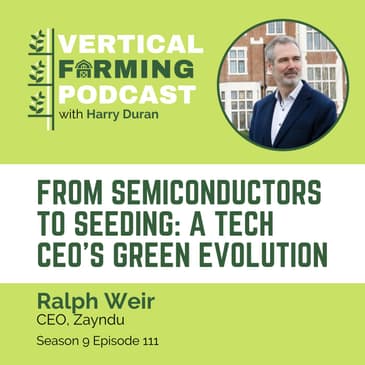
Growing up in the rugged landscapes of Scotland, our guest Ralph Weir, CEO of Zayndu, has traversed a fascinating journey - from the world of semiconductors and mobile television to the cutting-edge realm of vertical farming. Ralph's story is not just a narrative of professional evolution, but a testament to the power of adaptability and innovation. Join us as we uncover how Ralph's Scottish roots, his father's profound influence, and a chance encounter with the world of agriculture shaped his incredible journey.
Zayndu, under Ralph's leadership, is revolutionizing the farming landscape using plasma technology. This episode dives into the crux of their trailblazing work centered on leveraging plasma to enhance crop growth, optimize seeds per specific growing systems, and significantly reduce costs - transforming vertical farming into an accessible venture for small-scale farmers. We also ponder over the intriguing concepts of differential pricing and 'snooze mode' for seasonal planting, with Ralph providing us with his insights on the same.
Despite the numerous challenges posed by the global pandemic and Brexit, Zayndu's resilience and commitment to their mission remain unwavering. As we navigate through the complexities of leadership, the nuances of technology, and the future of vertical farming, we get a glimpse into the potential of decision-making rooted in facts, and the importance of clean seeds in a vertical farm. Tune in and get inspired by this compelling story of innovation, resilience, and passion for the environment.
Thanks to Our Sponsors
AgTech Marketing Team
Key Takeaways
0:00:01 - Vertical Farming and Scottish Origins
0:16:11 - Zayndu
0:20:26 - Leadership and Managing Through Challenging Times
0:27:13 - Plasma Technology in Agriculture
0:46:38 - The Future of Vertical Farming
0:57:16 - Discovering and Connecting with Inspiring Stories
Tweetable Quotes
"When you're in a hole, the bomb doesn't count the pips. His point was if you're doing a job it doesn't matter if you're a major or the lowest rank. The bomb doesn't care. You're a team, do it together."
"I think that in many ways, that transition from the world of semiconductors came through a series of other startups looking at things like aircraft efficiency and really starting to look at what can we do not to change the way people have to live, but to bring things into line to make what people need achievable within the bounds of what the world can provide."
"Plasma is this fourth state of matter. It's a high energy state and instead of having these very solid bonds that the ice had, they became looser with the water, looser again with the gas and we actually start to split up the molecules so they become separate ions and at that point a lot of interesting things happen."
Resources Mentioned
Ralph's Website - www.zayndu.com
Ralph's Linkedin - https://www.linkedin.com/in/ralphweirceo/
Ralph's Email - r.weir@zayndu.com
Connect With Us
VFP LinkedIn - https://www.linkedin.com/company/verticalfarmingpodcast
VFP Twitter - https://twitter.com/VerticalFarmPod
VFP Instagram - https://www.instagram.com/direct/inbox/
VFP Facebook - https://www.facebook.com/VerticalFarmPod
Subscribe to our newsletters!
AgTech Digest - https://agtechdigest.com
The Indoor Farmer - https://www.indoorverticalfarm.com/
Horti-Gen Insights - https://www.hortigeninsights.com/
Sponsor Links
Cultivatd’s Website – https://cultivatd.com/
Cultivatd’s Instagram – https://www.instagram.com/cultivatdco/
Cultivatd’s Twitter – https://twitter.com/cultivatd
Cultivatd’s Facebook – https://www.facebook.com/cultivatd/
🎙️🎙️🎙️
Podcast Production and Marketing by FullCast
Discover the best podcast services in the world at The Podosphere: https://www.thepodosphere.com/
Mentioned in this episode:
2025 Precision Ag Report by iGrowNews
2025 Precision Ag Report by iGrowNews
[00:00:00] As an industry we've got to get this right i think whether it's glasshouse vertical farms whatever we've got to move the agricultural output forwards i think we're a very big part of that story i think this number is.
[00:00:16] The story of agriculture using seventy percent of the water and now we're going to increase agriculture by fifty percent then you're in the right place if you're looking for a show where we interview fascinating CEOs and founders of the leading vertical farming companies from around the world. I'm your host, Harry Duran, podcasting since 2014 with my first show, Podcast Junkies, and founder of our full service podcast agency, Fullcast. In case you missed last week's episode,
[00:01:43] we had a great conversation with Robin Vincent dive on this. We talk about their trail basing work and how they're leveraging plasma to enhance crop growth, optimized seeds per specific growing systems and significantly reduced costs, which is really helpful for transforming vertical farming into an accessible venture for small scale farmers, which is something that's near and dear to my heart. We talk a little bit about differential pricing
[00:03:01] and what he's called the snooze mode for seasonal planting,
[00:03:04] which is an interesting concept
[00:03:05] and he'll explain that in this episode.
[00:03:08] Despite the numerous challenges posed our conversation. So don't worry about jotting down notes or pulling over the car to rewind a piece that you wanted to hear again. Rest assured you can always visit verticalfarmingpodcast.com. You can read the full show notes for each episode which includes all the guest links as well. Okay before we jump into this uninterrupted conversation with Ralph here are a few words from the
[00:04:20] amazing partners that support this show. This episode is brought to you by
[00:04:24] Hordie Agri next November 20th to the 22 show in livestock production and animal husbandry. This week will provide a comprehensive look at the entire Ag industry supply chain, both vertically and horizontally. Mark your calendars for the CEA Summit East in Danville, Virginia from September 19 to the 20th, 2023. This two-day event, co-hosted by Indoor AgCon and the Virginia Tech IALR Controlled Environment
[00:05:43] Agriculture Innovation Center, brings businesses and academia together to help you grow your
[00:05:48] business. It was actually through a friend who said you should be listening some of these Yeah, it's probably or Six months ago It's amazing what you can get with carplay in the car on the drive home. It's great. So I should be thinking your friend as well You know Mickey, yeah, yeah, yeah, and where are you calling in from?
[00:07:01] So yeah, I'm coming from Loughborough, which is between Nottingham and Leicester in UK. It's in the middle of this or they
[00:08:06] one bedroom, one other room, and a strip of land that ran up the mountain behind. And every one of the houses had this strip of land behind it.
[00:08:10] So it's a beautiful, fashioned way of life, largely gone, I think, overrun by bigger farms.
[00:08:18] And it has to be enough for the scale and just the economies of modern farming.
[00:08:22] Yeah, I've heard a lot of good things about Scotland.
[00:08:26] My partner's ex-husband is from there.
[00:08:28] So she's a lonely, it's a, by nature, it's a very different sort of climate. Yeah. Which is quite interesting. You start talking about indoor farming and indoor agriculture is the different perspectives you have. If you're down the far south or in the desert or in the far north, it's a very different set of criteria to what you might have in Texas or.
[00:09:43] Yeah.
[00:09:44] Most definitely.
[00:10:43] So, but that kind of stuck with me. It was the first person I'd ever heard talk about the environment and
[00:10:47] change in the environment.
[00:10:49] I think the other thing that was going on back then was my father had been a major
[00:10:54] in the war in the British army in bomb disposal, and that gave him something of
[00:11:00] unique attitude towards management style.
[00:11:04] He used to say that when you're in a hole, the bomb doesn't count the pips.
[00:12:03] something that I try to get in as much as possible. I still make DJ mixes on SoundCloud as well. Nice. So when I was at school in what the, it would be in the early
[00:12:09] 80s, I was building analog synthesizers. So you know, building keyboards, drum synths
[00:12:16] were my particular challenge. I was trying to build drum synthesizers. Okay.
[00:12:21] And some friends who were made proper musicians, as opposed to people
[00:12:24] tinkering with the electronics, started to your existing world view now? I think most of the early startups I was drawn to because it was cool technology, you know, things like OLED displays, so materials for OLED displays, semiconductor
[00:13:43] materials to improve the efficiency of LEDonductors came through a series of other star jobs looking things like aircraft efficiency and really starting to look at what can we do not to change the way people have to live but to bring things into line to make what people need achievable within the bounds
[00:15:02] of what the world can can provide h grasp of really what was being created what you were getting into? I've learned a huge amount about controlled environments. I actually live on a farm. I had that connection to the Croft back in the early days. So I knew a fair bit. I knew more than the average man on the street put it that way.
[00:16:21] I had also had quite a lot of exposure to things like LED lighting and understanding some of the applications of that, vertical farm at least. They can come in on the people, on the water, on the growing media, or on the seeds. That's your four options. So water you can sterilize, that's not a problem. Growing media, again, can be sterilized. People, you probably best not sterilize them, but you can probably wrap them up in there. I always think about those, every time you watch those space movies, they go through
[00:17:42] that chamber that sort of showers them with the lack of pesticides, the lack of need for controlling any bugs or contaminants, and I think,
[00:19:02] especially you coming from the semic medical industry or this MQ doctor business of keeping it absolutely clean. So this is for us, one of the things that we're bringing to that area is that ability to clean the seeds before they go in, block off that fourth, the fourth passage in vector. And that gets really interesting because of course, really you want zero-wash salads.
[00:20:25] That's the big ambition. this word, Zindoo, and it's based on one of the Basque words which just means to care for. And we all went, actually that is exactly what we're trying to do, we're trying to care for the environment, we're trying to do all this good stuff, taking away the chemicals, improving outcomes for growing. And it probably goes beyond that with the ultimate vision for the company in terms of
[00:21:43] the other approaches, the other things that we can do. And in that context of, I suppose as a family, we've always been, you know, the people who've been pushing to get recycling into our streets and all of this kind of thing, you know, we've always been at that sort of, that sort of end of trying to care for the environment as much as we can, being very aware of,
[00:23:00] of the constraints that the planet has.
[00:23:03] And when I described this to Jane, she just went, this is exactly what
[00:24:06] built the team out as well. So we ended up building out a fantastic team. I think it's quite interesting when you look at a team and just the way they react, you know, when
[00:24:12] because if you're a small company, you quite often are in a situation where there is one
[00:24:16] guy who's responsible for a whole area. And you can just see when somebody's under pressure,
[00:24:23] other people will be making them cups of tea and coffee going, Can I get that for you? to the quality of leadership as well. Because when you see companies that do it well and do it successfully, it's this really fine balance of ensuring that everyone is bought into the mission. And probably that's something that needs to happen. It's easier if you're hiring the person, probably a bit more challenging if you're stepping into an organization where there's already people there and they've had a previous leadership
[00:25:40] and you've got to now convince them
[00:25:41] that this is the new way of doing things.
[00:25:43] But I think feeling that everyone's moving
[00:25:46] towards the same mission, the same goal, Institute because they were fantastic. You were put on so many courses, management style, commercial courses. They've really invested in their people back in those days. And I can't speak for what it's like now, but they really helped a lot. I think there are several bosses along the way, some who would completely
[00:27:02] fail today's politically correctness tests, but yeah, some real characters
[00:28:04] that the company started in 2019, so naturally you had to make it through what the whole world experienced in terms of COVID. And that's when our show started in March of 2020. So I'm
[00:28:09] curious, what was the challenges you experienced as a leader and how you managed to do that
[00:28:15] to present day? Yeah, COVID was a real difficult time. Initially, there was the whole shock of
[00:29:27] In a way, we were on teams continuously, and I think that was very important to be giving each other support and a continuous interaction with other humans.
[00:29:33] So that worked pretty well.
[00:29:35] And then, of course, at the first point that the quarantine was relaxed, we had to talk
[00:29:40] about how we would continue to work with social distancing.
[00:29:44] Well, at that point, the company was access to the basic physics of what the machine was doing and evolved a lot through that period. A lot of the sensors and control evolved further since then, but a lot of the first prototypes were put together
[00:31:00] through that phase. So we achieved a lot, tax office, so it's the IRS. And chatting to a lady at HMRC and said, oh, I'm terribly sorry, that's my baby crying in the background. That would not have happened
[00:32:20] pre-covid. It's just normal now. It's normal. Yes. And I know there's been words thrown around in some of the press releases and some of the talks that you've been giving all plasma technologies, which sounds really fancy, but I think for the benefits of this audience, if you could give an overview of what you're currently working on and who an ideal customer would be and then some of the current projects you're working on. Sure.
[00:33:40] So
[00:33:41] going back to the founding of the company, what Felipe was describing to me was
[00:33:47] using of ice. The block of ice is solid, it does not behave like water, and you can see this. If you put the block of ice into a microwave, it doesn't melt. And the reason it doesn't melt is because a microwave works by moving the molecules around. And the block of ice, the molecules are a lot solid, they're not going to move. So somehow you're going to
[00:35:01] put some energy into that ice and it turns into water. And now the microwave does have quicker. It actually makes the seed germinate more consistently so the growers will talk about synchronizing a crop. Synchronizing a crop is a strange thing. If you're a home grower it's your worst nightmare. You do not want every lettuce you ever planted to be ready for picking on Wednesday. You'd be quite happy if one was Tuesday, one was Thursday and one was sometime next week. But for a commercial grower synchronizing is a very
[00:36:22] important factor and we get that through creating these microfishers. At the same time we're the hormones to adapt the way the seed is going to perform. What we try and do is throw them, to treat the hormones, so it throws a bigger, better root system very early. And of course, bigger, better root system means bigger, better seedling, which else about it? So we're starting to get a few out that are opening up a little bit. But generally, the proof points that we have end up being some of the big public organizations, people like NIHAB in the UK. NIHAB is the National Institute for Agriculture in botany.
[00:39:01] So they've run a bunch of trials.
[00:39:03] So seeing Basel at plus 30%,
[00:39:07] they were pretty chuffed with that. do is some fine tuning and the fine tuning gets to be really interesting because we fine-tune for the crop but also for the growing system because there is a huge difference between the sorts of parameters that are important in aquaponics post-seed sprouting, seedlings, anywhere along that process? The systems that we're building are all about this seed NYC, is there talk scheduled as well? No, not. Okay. We've had a small family crisis and so I'm not speaking it in New York. However, Alberta
[00:43:03] Campanaro, Dr. Campanaro, who is our head of plant science, is taking that slot. I learned in all the new CEOs and founders I've met who I'm sure I'll have a new list Tends to happen at these conferences. So Ralph. I also want to ask a question That's common and as a regular listener, you might know what's coming. But what is a tough question? You've had to ask yourself recently Gosh, I think the toughest question that I've been struggling with
[00:44:23] relates to the
[00:44:24] pricing model for what we're doing
[00:44:27] now We have to drive some of the costs out of the machine. You can imagine these first machines are probably over-engineered. We can probably get a bunch of the cost out and bring it down. But at this point, for the container farms, these things that we've been suggesting to people are, you know, there's a few farms in an area. Let's set up some sort of cooperative or collaborate with a cooperative
[00:45:40] to get something in there.
[00:45:42] It's interesting in that the ag-chem market use differential pricing.
[00:46:46] To see those improvements in growth time and yields, I think anyone who's in this space is obviously looking to, a couple of days could mean a big deal for some of these smaller
[00:46:51] farms especially shaving off the time from those cycles.
[00:46:55] Some of the, I keep calling them microherbs, but the microgreens, they're only growing
[00:47:01] for 10 days.
[00:47:02] If you can shorten that cycle by two days community forum or whatever space we're creating here. But I've been glad to have, giving my guests this opportunity. We've been hearing some interesting thoughts and I'm just curious about what your thoughts are as we get ready to head into this conference and I'll be connecting to a lot of your peers
[00:48:20] and colleagues in this space.
[00:48:21] Any thoughts that you have? I thought I'd be different, I thought I'd go in there, I thought I'd be the voice of reason and now I realize I'm buying along with the rest of them. It's just one of the sheep in the herd. And I think there's a danger of that that's going on. I think we market of people just listening to what people are saying, getting brainwashed. I'm not saying that America isn't the greatest country, I'm just saying that you know we should all be making decisions based on what facts we can get our hands on, not what perceptions that we have, because the
[00:51:02] world is different. And you see the coming into the vertical farming space, to see where there's hybrid models that are being applied, I think that makes a lot of sense and I think people, there's
[00:52:21] always opportunities to learn from other industries that have had a leg up and
[00:52:25] been doing this for a while. So I think we have as an industry we've got to get this right. I think whether it's glasshouse, vertical farms, whatever, we've got to move the agricultural output forwards and I think we're a very very big part of that story. I think this
[00:53:41] staggering number is the story of agriculture using 70% of the earth's
[00:53:45] water and now we're going to increase inspired on all the different paths that people are taking to contribute to what we're all working towards. So thanks again for coming on and sharing your story. It's been an absolute pleasure, Harry. Thank you for the opportunity.
[00:55:00] And so zainduzayndu.com, anywhere else you want to send folks to connect with you?
[00:55:05] I think that would be the main video. As a reminder, if you've enjoyed this episode or past episodes, do me a favor, leave me a rating and a review at ratethispodcast.com forward slash vfp. Nothing makes me happier than to read those out on future episodes. And don't forget to tune in next
[00:56:20] week for a conversation with yet another fascinating leader from the world of vertical
[00:56:24] farming. Until we meet again, here's to your health. Thanks for listening. To read the full