
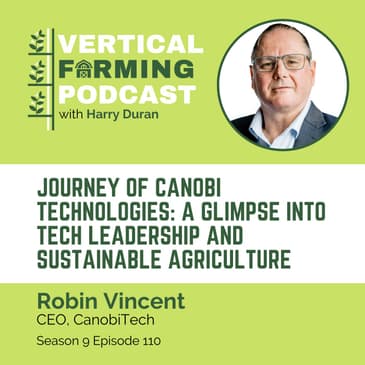
Have you ever wondered how the world of technology collides with the world of agriculture? Prepare to be spellbound as we sit down with Robin Vincent, the tech-savvy CEO and CINNO of Canobi Technologies. Robin takes us through his fascinating journey, from his early fascination with technology and his evolution from infrastructure architect to CEO. He paints a vivid picture of his personal project to reduce the mortality rate of stingrays and seahorses, a venture that guided him towards the creation of Canobi.
The conversation takes a deep dive as we explore the company’s growth, challenges, and its unique product offerings. Robin enlightens us about their Agri-agent network, and the relentless testing that takes place in their in-house lab. From the plains of Kenya to the valleys of South Africa, we traverse the rising interest in agriculture, the impact of Canobi Academy's online education, and the exhilaration of being part of a nascent industry. We also touch on the upcoming Green Tech and Innovation Summit conferences and the ripple effects they will have on the industry.
As our conversation winds down, we delve into the innovative world of vertical farming, looking at energy efficiency and the potential of integrating different technologies. Robin talks about the importance of collaboration, the richness of experiential learning, and how Canobi Technologies is empowering farmers with technology. Robin's optimism and excitement for what lies ahead in the vertical farming industry are infectious. So join us on this insightful journey with Robin Vincent!
Thanks to Our Sponsors
AgTech Marketing Team
Vertifarm - Use code VFPODCAST23
Key Takeaways
0:00:20 - Navigating the CEO Journey
0:03:44 - Love for Tech and Electronics Origins
0:21:50 - Ubuntu Wellness and Growing Nutritious Food
0:26:36 - Conference Travel and Networking Discussion
0:33:43 - Energy Efficiency in Farming Innovations
0:39:26 - Loneliness and Challenges of Entrepreneurship
0:43:04 - Importance of Social Component in Organizations
Tweetable Quotes
"I see the world as vastly unfinished... I see solutions, I don't really see problems."
"We learned an awful lot more from our failures than our successes. While we're busy trying to break everything and figure out how not to grow strawberries, we're also trying to figure out how to keep them going."
"Every single human being on this planet could have access to food. We now have the technical ability to grow food anywhere on this planet."
Resources Mentioned
Robin's Website - https://canobiagtech.com/
Robin's Linkedin - http://www.linkedin.com/company/71643741
Robin's Email - robin.vincent@canobiagtech.com
Robin's Twitter - http://www.twitter.com/canobitech
Robin's Instagram - http://www.instagram.com/canobitech
Robin's Facebook - http://www.facebook.com/CanobiTechnologies
Robin's Youtube - https://www.youtube.com/@canobiagtech
Connect With Us
VFP LinkedIn - https://www.linkedin.com/company/verticalfarmingpodcast
VFP Twitter - https://twitter.com/VerticalFarmPod
VFP Instagram - https://www.instagram.com/direct/inbox/
VFP Facebook - https://www.facebook.com/VerticalFarmPod
Subscribe to our newsletters!
AgTech Digest - https://agtechdigest.com
The Indoor Farmer - https://www.indoorverticalfarm.com/
Horti-Gen Insights - https://www.hortigeninsights.com/
Sponsor Links
Cultivatd’s Website – https://cultivatd.com/
Cultivatd’s Instagram – https://www.instagram.com/cultivatdco/
Cultivatd’s Twitter – https://twitter.com/cultivatd
Cultivatd’s Facebook – https://www.facebook.com/cultivatd/
🎙️🎙️🎙️
Podcast Production and Marketing by FullCast
Discover the best podcast services in the world at The Podosphere: https://www.thepodosphere.com/
Mentioned in this episode:
2025 Precision Ag Report by iGrowNews
2025 Precision Ag Report by iGrowNews
[00:00:00] Today we grow with a combination of LEDs and lasers.
[00:00:03] And with LEDs, we cut our energy footprint
[00:00:05] by probably around 50%, maybe even more.
[00:00:08] And with lasers, we may be able to get it down to maybe 35%.
[00:00:12] And I don't think we've even scratched the surface yet.
[00:00:15] And we're realizing a lot about the plant.
[00:00:17] I think a lot of the time there was the assumption
[00:00:20] that you hit them hard and hit them hard
[00:00:23] and hit them all day long.
[00:00:24] Well, there's not a lot of organic systems
[00:00:26] that do well under those situations. conversation with Lottie Van Kain. We talked about her experience in greenhouses, her desire to circumnavigate around the world by water, and all the innovations that have been happening in that industry, and how much experience folks that are coming from the greenhouse side of things are bringing into the world of Oracle farming. Very, very helpful and informative episode you to focus all your energy on our conversation. Rest assured, you can always visit verticalfarmingpodcast.com to read the full show notes for each episode, which includes all our guest links as well. Excited to be hitting the road at the end of this month, September, 2023, as I record this, I'm heading over to the Vertive Farm Conference in Dortmund, Germany, which is gonna be very exciting.
[00:03:02] I've never been in that part of the country before,
[00:03:04] and it's gonna be an interesting day of travel for me
[00:03:07] coming from Minneapolis. ideas for collaboration with Virginia Tech and IALR researchers as well. Vertical Farming Podcast listeners can save 10% off the standard passes with code VFP. Visit CEASummit.com for more details and to register. This year, VertiFarm takes place from September 26 through September 28 at the Exhibition Center in Dortmund, Germany. For those new to VertiFarm, it's the
[00:04:22] most significant trade fair for next-level farming and new food systems. company, I'm enjoying the CEO role a lot more than I thought I might. But I still like to keep it very clear that I'm still one of the, well, I am the lead technical engineer behind the entire thing. Yeah. And so talk a little bit about folks who may not know your background. I've seen you've got a long list of leadership positions previous to Kenobi without having to go through
[00:05:42] the entire resume. What are some of the highlights I've always been more, I think of a shop foreman than a manager. I always like being out on the shop floor and even though it's computers and that's, there's not a real floor, but yeah, I like being out there working with the guys and keeping a bit of a technical role.
[00:07:01] Yeah.
[00:07:01] So I always like to think about this because of the era that I grew up.
[00:07:05] So I was born in 1970, but do you remember your very first computer?
[00:08:01] Yeah, that's quite special.
[00:08:05] Where did you think your love of technology and then, you know, all things related to computers come from?
[00:08:07] Well, my father owned an electric computer company, actually a small
[00:08:11] computer company in England, which is how I ended up getting into electrical
[00:08:14] engineering because, you know, I wanted to work there.
[00:08:17] So, but back then you needed an electrical engineering degree to service computers.
[00:08:21] I mean, that was back when we were using oscilloscopes and troubleshooting chips.
[00:08:24] And, you know, it wasn't the rip and replace that it is today.
[00:09:23] reminds me when I was younger, we would get, we would buy furniture and that would be the first one to race to my parents and volunteer and put everything out on the floor and then
[00:09:28] the paper and just organize all the tools and everything, make sure everything that
[00:09:32] was in the sheet was included and then get to work like a huge puzzle piece or something
[00:09:36] to work on.
[00:09:37] Yeah.
[00:09:38] You mentioned this idea of enjoying your time on what you called the shop floor.
[00:09:42] It's important for you to always, you know've been very, very lucky and very fortunate in my career to work with some really good managers.
[00:11:02] And I think that's the way life is.
[00:11:03] You sort of, you know, you take in the home aquarium industry. And to be honest with you, I just saw that was disgusting and actually didn't even want to be a part of it if that was the norm. But at the same time, I've always enjoyed that area. So I just kept at it and thought, well,
[00:12:23] this is obviously probably most likely transplant shock. And I decided to step out of my own. And I just thought, well, I think we're there. I think we can probably use all of the experience I have in managing data centers and environments and apply everything I've learned in my career
[00:13:40] to the indoor farming volume of air and see what I could do.
[00:13:45] And of course at the time,
[00:13:47] most of what was going on was in indoor. medical candidates learned an incredible amount. But then COVID happened. And so end of 2019, beginning of 2020, we were already doing some work internationally with some of our agri-agents. And COVID happened. And the door just swung wide open on the mid-sized farm i think it's. Got a great deal of social value it creates the jobs i think it's got its own challenges which is great it's very challenging area and i like dealing with those types of businesses so it's where we are today.
[00:17:25] us grow organically. We haven't had this massive cash infusion where we just sort of expand as quickly as we can. It's been quite organic growth. So I think that's also helped us with each
[00:17:31] decision. It's been, okay, where do we have a gap? What do we need to fill? And do we have any
[00:17:35] redundancy in these areas? For the benefit of the listener who may not be familiar with Kenobi,
[00:17:39] can you talk about present day, what the current your farm. It has an industrial level PLC automation component. So essentially what you're monitoring, you can also manage. So you can manage your fans, your HVAC,
[00:19:02] and all of the electronics and components within the farm.
[00:19:05] And then we also have the business tools,
[00:19:07] which is a fully RP. is to want to control it and do more with it. So we're certainly there to help with that. And it's one of the reasons why we stay with, we're very focused on the mid-size farm because when you start getting up into the much larger farms, the requirements of our business would have to go up in order to meet their requirements.
[00:20:20] So with a mid-size farm,
[00:20:21] we're able to keep our team efficient, relatively small.
[00:20:25] And we still are a very small team.
[00:20:26] We're about 13 or 14 full-time, trying to call it, you know, breaking it. We want to look at what happens when it breaks, identify how things break, what breaks first. And, you know, because of that, we also focus on a lot of very challenging crops. And right now, one of those challenging crops is strawberries. So while we're busy trying to break everything and figure out how not to grow strawberries, we're also trying to figure out how to keep them going. So it's kind of a very cool environment.
[00:21:43] And I'm like that, I have been on my whole and seeing how they grow. But the real focus is on the environment profiles, what grows with what, what can grow in the same nutrients. There's no doubt that the vertical farming and end-of-farming industry is very new. And I think that there's a lot of data coming out of universities, very useful data. But much of that
[00:23:03] data, it's not combination data. It doesn't say time to eat them because you're there to grow them. I mean, we grew a two and a half foot diameter lettuce at one point. It wasn't very good, but we grew it.
[00:24:20] So that kind of forced us into a pattern of,
[00:24:23] okay, well, we're growing it, but we wanna make sure
[00:24:24] that we will, when are we harvesting it?
[00:24:26] Are we harvesting it early or late? of growers. So I said, Okay, you grow the strawberries in our lab. I'll come down there. He's an agri agent of ours now and I'll meet some of your clients. So I went there and as it turned out, we're dealing with our lighting partner is now from South Africa. And we have a product called the micro farm and that is actually a manufacturing part of it in South Africa as well. So going there actually led to a whole ton of benefits.
[00:25:44] Has that opened your eyes to the opportunities skills and their interest in agriculture. I mean, sure, it's driven a lot by what happened with COVID, but I think also there's a lot of people that want to rebuild the relationship with their food and through farming as part of that revenue or that avenue.
[00:28:04] Yep. Yeah, we're the next big one for me is green tech which is next week Yes, and then we're at the summit the innovation summit in New York in two weeks. Oh and I'll be in there
[00:28:11] I'll be there as well
[00:28:14] Yeah, I'm probably gonna travel a little less than I did last year last year was I love traveling
[00:28:19] But I gotta admit by the end of last year. I was like, wow, okay
[00:29:23] really wild. You know, it's, it's very cool. There are so many great ideas out there. There's so many great products and people
[00:29:26] that are working really hard. It's really cool.
[00:29:29] Yeah, it's been exciting. Really right for me because I actually
[00:29:33] started it in March of 2020. The show was think about timing just
[00:29:38] before COVID hit and it wasn't intentional. But all the things
[00:29:41] that happened because of COVID to your point and supply chain
[00:29:46] disruptions, access to fresh. We now have the technical ability to grow food anywhere on this planet. Yeah, it's really exciting. And obviously with new industries, there's a lot of hype and we've seen a lot of news about companies getting a ton of funding and to your point earlier about companies that receive VC
[00:31:04] funding and we've seen how some of those have here. There's been a tremendous amount of innovation that have brought down the energy footprint of an indoor farm. And on the other side of that, you have the renewables coming up in efficiency. So, you know, we ourselves, you know, started out the same way as everybody else. We were growing
[00:32:21] with metal halide or sodium lights, horribly inefficient with the energy increases from our nose, we're getting very close to the fact that with a high efficiency farm, you would actually be better off planting solar panels that could then power the farm and they would actually
[00:33:44] be surplus at certain times of the day, which is them shaving a little bit off that cost and making things more efficient where we know of a chiller that is out of Korea that, I don't mean there's other people that make them, they're absorption chillers, they turn waste heat into cooling. So you're not paying as much on the electricity side to do your H drive.
[00:35:00] So there's all kinds of things going on all over the world that may or may not be suited you've got to deal with the heat. So lighting is definitely somewhere that I think I see a tremendous amount of innovation and it's one of the reasons why we're partnered with RadCorp, the company in South Africa, because they are spending a tremendous amount of time innovating regarding shifting light spectrums and doing a lot more to replicate what goes on in nature than
[00:36:22] just lights on, lights off. So I think there was a triple tier installation. So obviously, experts in the racking space would probably be the first folks who'd be interested in maybe partnering or having conversations around what's the best use of making all these combinations work most efficiently. Yeah, that's it. And I mean, you know, there's the two big train of thoughts, which is get the human
[00:37:40] to the plant, the plant to the human.
[00:37:43] So many verticals are, you know, sort of chairlifts probably because I am an infrastructure guy on the back end. So the technology problems don't phase me very much. It's the business, but it's lonely. And you know, you've got to be honest with yourself. So that's not easy. Yeah, as a fellow entrepreneur, I can definitely relate to the lonely aspect
[00:39:03] of the journey and having to figure it all yourself sometimes. And so when you think about who would be an ideal client or who would make sense to partner with Kenobi? So the ideal client for us would be anybody that is either entering into this space, and we have some very, very small clients
[00:40:20] with the goal of growth.
[00:40:23] So I wouldn't say that a guy that wants to grow
[00:40:26] in his garage or in his shed in the back think that's every business, as you mentioned, that I've seen go straight to the $1,500 million facilities. It's a much tougher game. I mean, we do it all the time. We're always swapping out crops and technologies. And boy, we really run into the wall sometimes. And doing that at 400, 1,000 plants, you can learn a lot from that. But doing that at 1 million plants, I'm not sure.
[00:41:42] That's more of a splat than it is in education. So yeah, I think that companies that are looking in come from agricultural families and you ask them do you want to be in agriculture and they'll tell you absolutely not right. Dirty, my you know parents are exhausted, tired, sick, tractors no chance but when they aren't from their cell phone tablet for two months it's a completely different
[00:43:00] thing. Take a strawberry and actually eat it when it's ripe. It's a whole different environment and
[00:44:04] keep going with what we're doing. I know that there's a lot of negative press at times about indoor farming and control environment farming. There's a lot of climatic pressure on greenhouses
[00:44:11] and consolidation is always there to help. So I think that my message would be that rather than
[00:44:20] consolidation with all of these technology events was not exciting. Yeah, Kenobi itself does not have any core competencies yet in AI. And I believe in growing through, you know, partnerships and sort of a modularity, we got along really well see a lot of things, I think, in the same way. So we sort of have a vector to help
[00:45:40] them commercialize. And I think what they're doing is absolutely
[00:45:43] fantastic. I think mid sized I'm going to encourage listeners to check out all that your extensive blog posts. There's a ton of content there. The website is canobiacttech.com, but we'll be sure to include all the links in the show notes and it's so exciting to see how your career trajectory is almost like prepared you for this moment in time to take advantage of this. And so I'm really excited for the future and can't wait to hear more and to hopefully get
[00:47:02] to meet in person at an upcoming conference.
[00:47:04] Excellent.
[00:47:05] Yeah, no, it's been great.
[00:47:06] Thank you very much for having me.
[00:47:08] Okay. launching, visit fullcast.co and watch the free video. As a reminder, if you've enjoyed this episode or past episodes, do me a favor, leave me a rating and a review at ratethispodcast.com forward slash VFP. Nothing makes me happier than to read those out on future episodes. And don't forget to tune in next week for a conversation with yet another fascinating leader from the world of vertical farming.
[00:48:21] Until we meet again, here's to your health.
[00:48:23] Thanks for listening.
[00:48:24] To read the full show notes for this episode, which includes any links mentioned in the